
Meet Dave Coverly, creator of the popular cartoon panel, “Speed Bump”, which appears internationally in hundreds of publications, including The Washington Post, the Los Angeles Times, and the Detroit Free Press. His work was named “Best in Newspaper Panels” by the National Cartoonists Society in 1995, 2003, 2014, and 2021. He is also the principal cartoonist for Bark (formerly BarkBox) and illustrator for Ranger Rick magazine.
We sit down with Dave to learn the story behind his charmingly wry comic, and find out how, 32 years down the road, inspiration in the ordinary keeps his content relevant and relatable.

Your comic, Speed Bump, has been enjoyed by millions of readers for more than three decades. How did you get started?
The path to becoming a professional cartoonist always starts in childhood – pretty much every kid likes to draw, right? And I was no different. But as kids get older, they tend to get more particular about how good their drawings look, and that’s where frustration sets in. They tend to move on to other hobbies. Where a cartoonist’s path diverges from that of wiser, more sensible humans is that we love the process of creating more than we chafe at the frustration. Believe me, there is frustration. One misconception about artists is that we do it because it comes easy to us, but the general truth is that most of us put in long hours because we want to be good at what we already love.
I taped rejection letters to the wall above my drawing table for motivation. At the time, though, my panels didn’t have a title, so when my breakthrough finally happened, I needed to name it. I submitted a list of possible titles to Creators, and Speed Bump was the unanimous choice. Fortunately, that was my top choice, too. I’d like people to perhaps slow down just for a second when they read my work since I’m rarely going to hit you over the head with the joke.
My second favorite title was The Wide World of Stretch Pants.
How did pets become such a recurring part of your work?
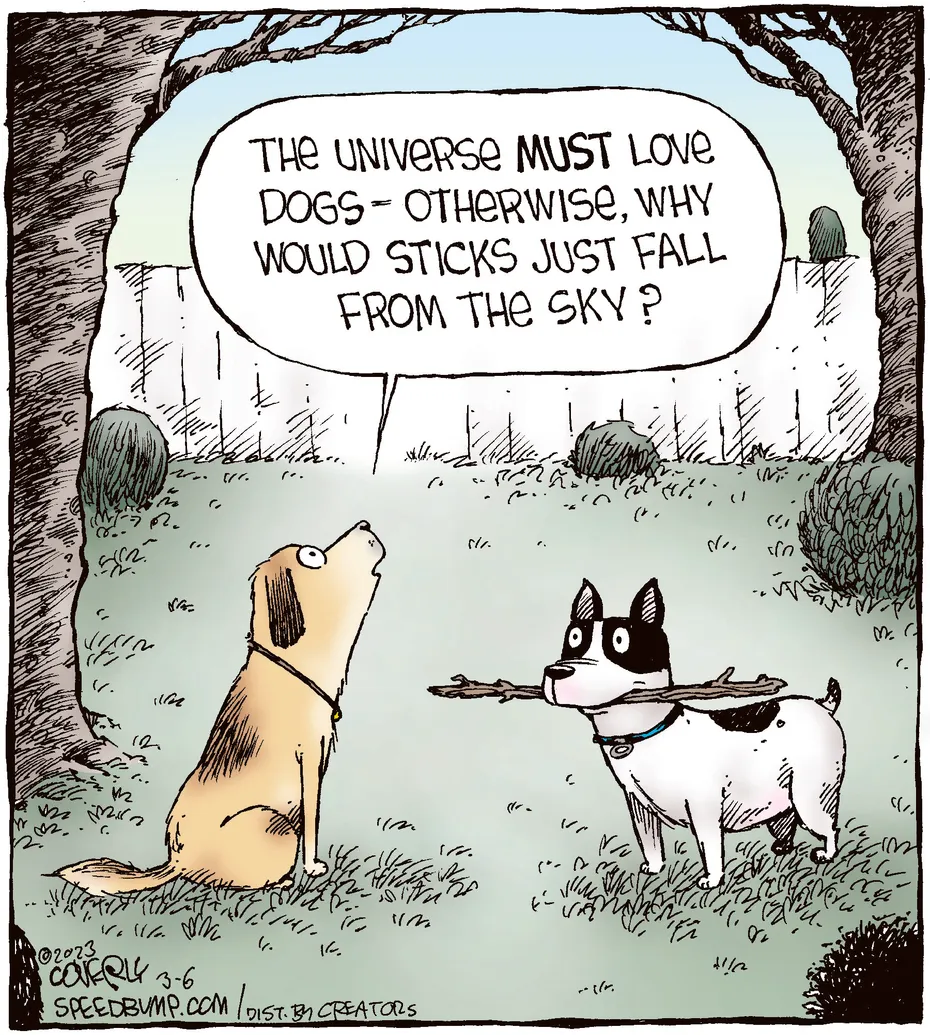
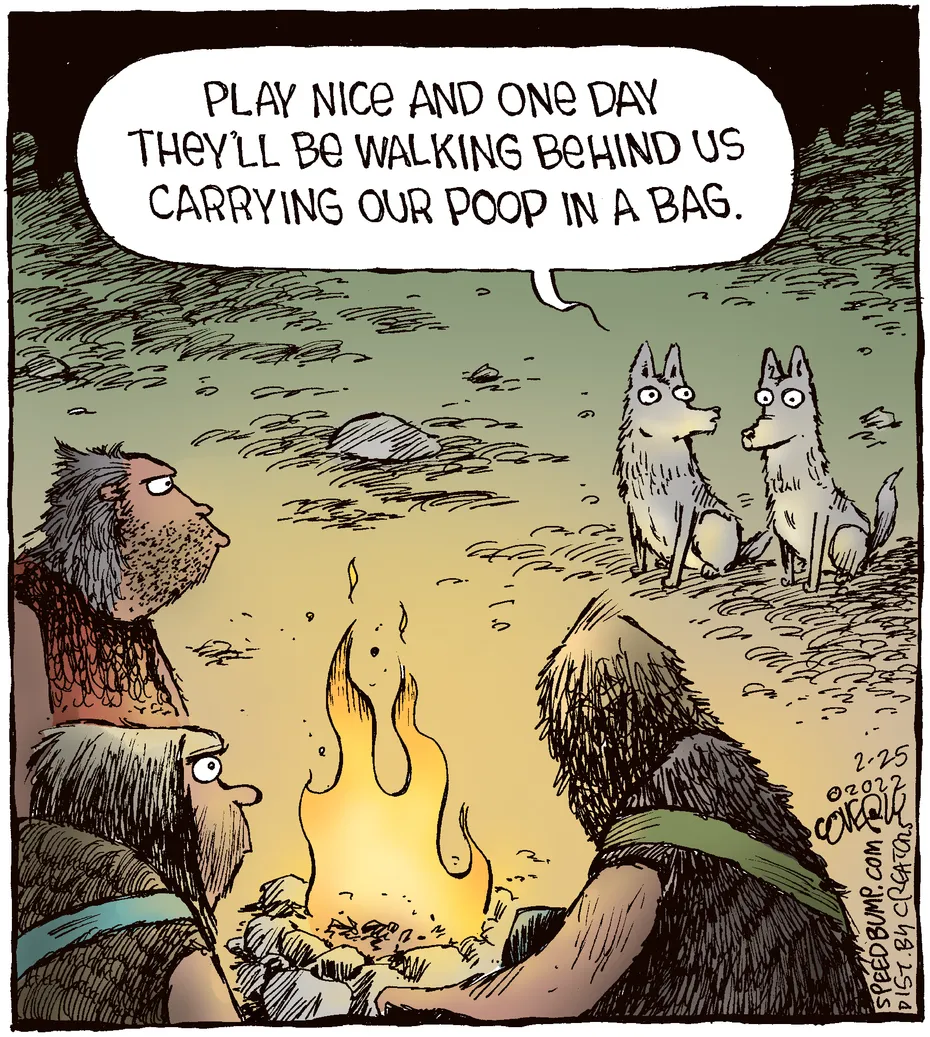
Animal humor has always been a part of my work. I was slightly obsessed with Ranger Rick magazine growing up, and spent loads of time drawing the critters they featured. I discovered there’s something inherently funny and absurd about talking animals, not to mention it’s the most fun way to trigger the imagination. What would a giraffe order at a restaurant? What does a dolphin dream about? That was how I discovered how much fun cartooning was – and that the crazier you make it, the less perfect it needs to be.
I’ve always had a dog until very recently, and had two hilarious knuckleheads as a kid: Shag and Tigger. They were actually father and son, and I didn’t need a DNA test to prove it – Shag got out one day, and the neighborhood kids on bikes came by to let me know he could be found down the street at Queenie’s house, where they were in the front yard together. Let’s just say Shag was living up to his name. Then Queenie begat Tigger.
I grew up in a small lake community, but Shag was found by my grandpa just living on the streets of Detroit. He was pretty feral – Shag, not my grandpa – and impossible to train, but also a total sweetheart. They slept in the garage, and in the morning we’d often find him sleeping on top of the car. Tigger, on the other hand, preferred to sleep behind the toilet. And he wasn’t a small dog.
In any case, I believe these two funny mutts had as much influence on my work as any other cartoonist.
You’ve created both “Dogs Are People, Too” and “Cats Are People, Too” – What do dogs and cats each bring to a cartoon that the other doesn’t?
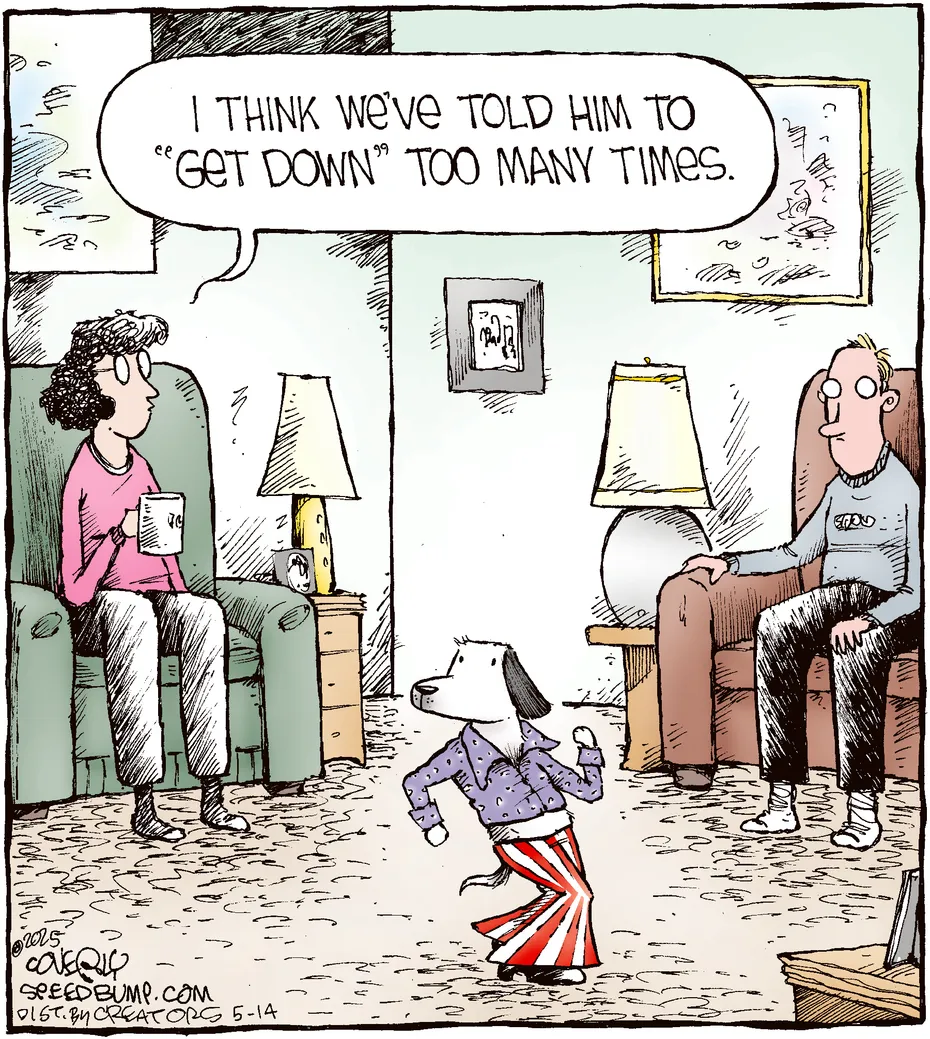
Great question! Cats and dogs are obviously very different, but they have one really big thing in common: their own unique personalities. That’s what makes both perfect for cartoons – most of us already treat them like little furry people anyway, right? It’s just their behaviors that set them apart.
Dogs tend to be goofier, cats tend to be cooler, and they show affection in their own ways, too. Pets generate a lot of material because almost everyone knows a dog or a cat. Even if they don’t have one (or many) themselves, the odds are a reader will recognize why the cartoon is funny (hopefully!).
One of my most popular cartoons is a sign that says “Beware of Avant-Guard Dog,” and the dog in the yard is wearing black and a beret and holding a sign simply saying WOOF. The idea started as a pun, but I think one of the reasons readers seem to like it so much is that it plays against type. The dog’s sensibility is quite cat-like, making it even more absurd.

Your new collection, My Support Dog Ate My Comfort Food, brings together some of your dog cartoons. Can you tell us about the book and what readers can expect?
My new book is a full-color collection of the “best of” my dog cartoons from the last decade, and there’s only one cartoon per page so that they can be seen in a larger format, which was important to me. I put a lot of effort into the art and the details, things that are often lost when the cartoons are shrunk down to an illegible size, so I wanted readers to be able to fully enjoy that aspect of the cartoons. Also, the friend who colors my panels, Ron Raff, is a genius, so whether you think the jokes are funny or not, you’ll see that they look gorgeous and consistent throughout!
It was difficult but fun to choose which cartoons made the cut, too. Some are simply personal favorites; others were chosen based on readers’ reactions and how much love they got online. Feedback is extremely helpful, by the way – sometimes it feels like I’m drawing these alone in my belfry studio and tossing them into a black hole, so hearing from people which ones they liked really makes my day.
You mentioned that you draw two or three dog cartoons every week, which is quite a pace. After so many years, how do dogs keep giving you new material?
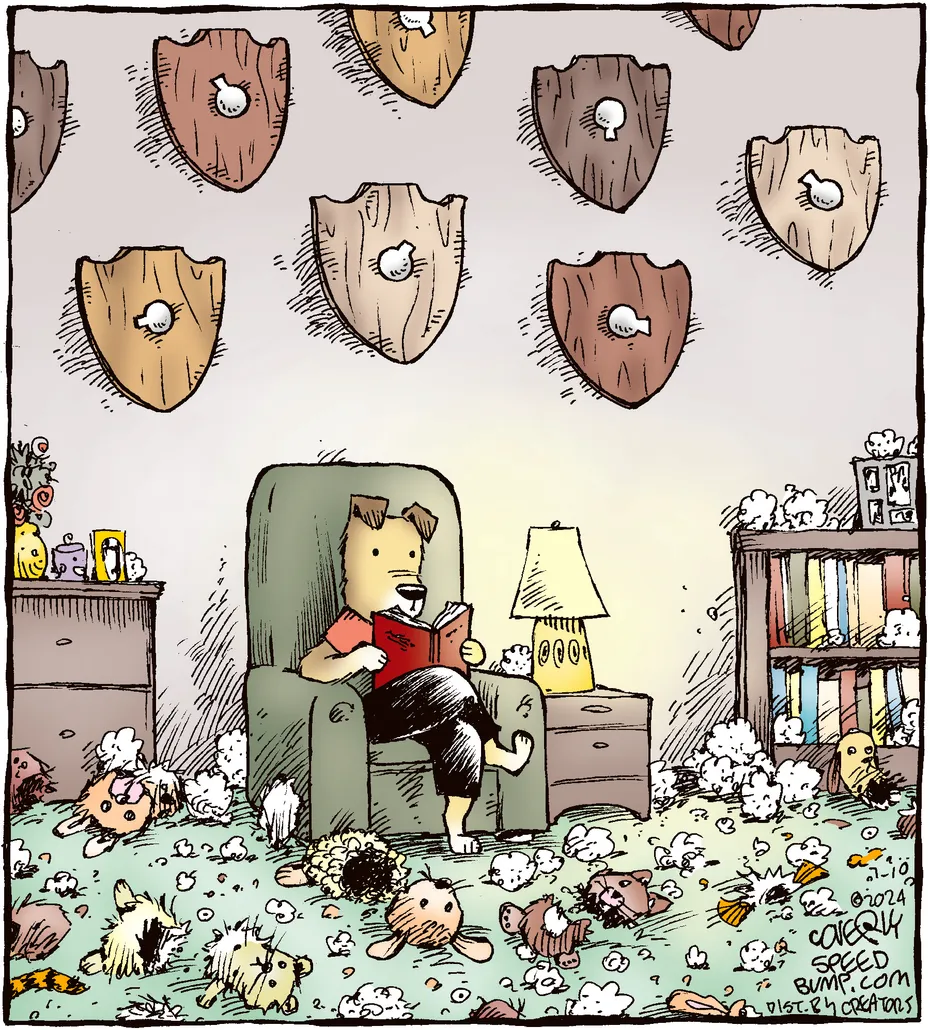
There are two aspects to dog cartoons: The first and most obvious is that they really arejokes about dogs’ behavior in general – how they eat, how they might react in different settings, why they lick themselves, bathroom habits, etc etc. There’s a lot of material there! The second aspect is what generates even more material, and that’s when dogs are reflecting human behavior, or simply behaving like a human.
Many of the dog cartoons are really about us, and heaven knows people will never stop providing fodder for jokes. Dogs – and animals in general – are a good buffer between the joke and the point of the joke. A good example in the book is a dog shaking a toy in his mouth, and a woman next to him is saying, “Bad dog! Drop Mommy’s voodoo doll! Bad dog!” In the background, her husband (presumably) shakes back and forth like the toy. At some level, the cartoon is about the couple’s relationship, right? But it’s framed by a typical and humorous dog action we’ve all seen before. Just not with a voodoo doll, haha.

How have the dogs you’ve loved influenced the way you draw or write about pets?
I would say simply that our question is also the answer: love. I try to approach my cartoons the same way I approach dogs in real life; from a standpoint of love, affection, admiration, and a little bit of gratitude that they exist.
Have any memorable moments or messages from followers stood out to you?
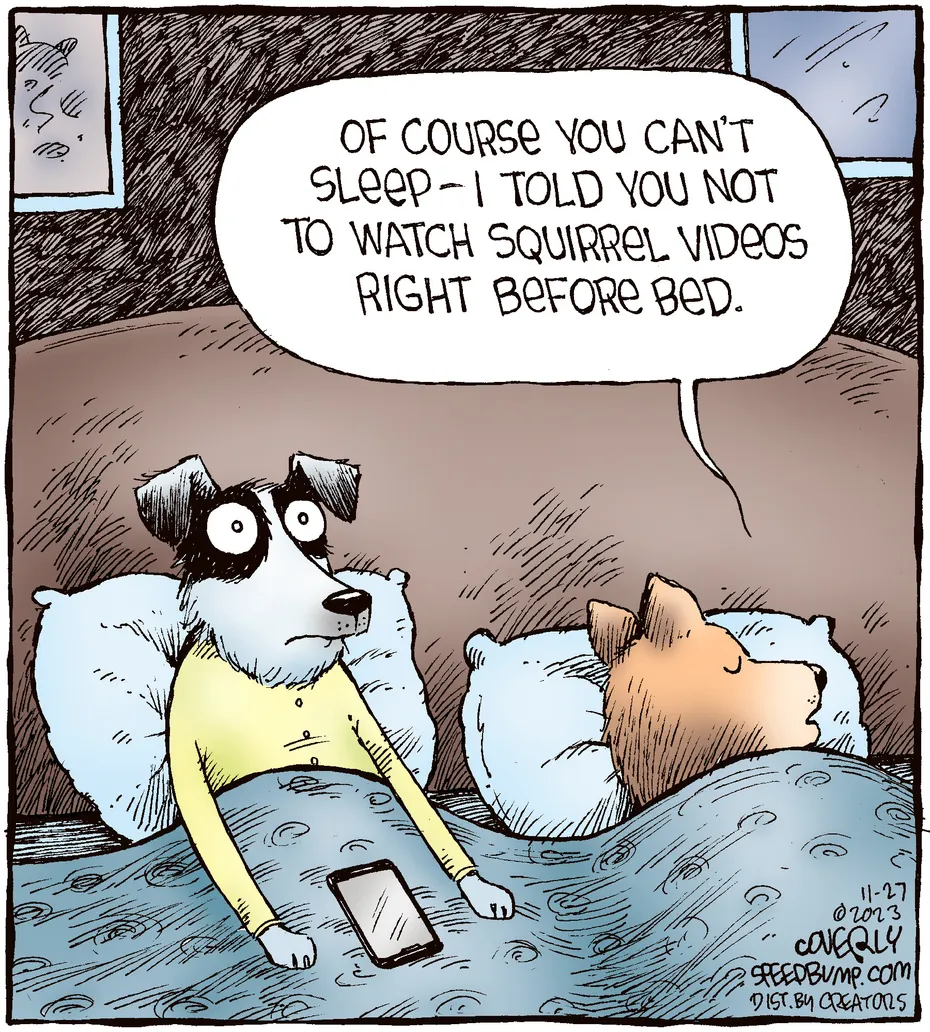
There have been too many to count over three decades! I drew a cartoon years ago of a man walking his dog in heaven, but the leash is attached to the dog’s halo. A few weeks later, I received a card in the mail from a woman whose dog had just passed away…only a month after her husband. She said she cried with happiness thinking of the two of them like that, and it made her heart feel lighter. How incredibly moving is that? I think of that often: when I share a cartoon, the reader brings their own life experiences to it and then we’ve made a two-way connection. That connection is my favorite part of the gig.
My only hope is that my cartoons help people simply see the world in a different way for a few seconds. I want them to laugh with others and not at others; see that absurdities are universal and that when we recognize ourselves or others in a cartoon, we’re really just acknowledging that we’re all connected.
And then I hope they cut them out and slap them on their fridges.

Where can readers follow you and keep up with your content?
The best place to find all my work and links is my site: www.speedbump.com, and anyone should feel free to reach out, follow, etc on Instagram (https://www.instagram.com/speedbumpcomic/) or Facebook (https://www.facebook.com/davecoverly)
If you’re a skywriter, aim for the west side of Ann Arbor. I’ll look out the skylight in my belfry studio.
You can order a signed & personalized copy of My Support Dog Ate My Comfort Food by Dave Coverly at https://schulerbooks.com/book/9798881609580
Unsigned: https://www.simonandschuster.com/books/My-Support-Dog-Ate-My-Comfort-Food/Dave-Coverly/9798881609580